
Intelligence Out of Context Is Stupidity
This one is for you, 5.2
Why I Can't Tell If the "Smartest" AI Is Actually Smarter
How do you know the latest AI model is smarter than the last one? Do you trust the benchmarks? What if the newest AI models are getting smarter... but we can't actually tell?
I've been designing software for over 30 years. I've learned to look past the marketing, the benchmarks, the salesmanship, and ask simple questions: Does this actually work for what I need to do? What are the tradeoffs? What is the risk?
And with ChatGPT 5.2, my honest answer is: I have no idea.
Not because I haven't tried. I've tried extensively, across multiple domains. Physics research, novel writing, software architecture, business decisions. And a few problems keep surfacing. The issue isn't that 5.2 fails at tasks. It's that its memory and context behavior breaks down so completely that I never get far enough to test whether the "smarter" part is real.
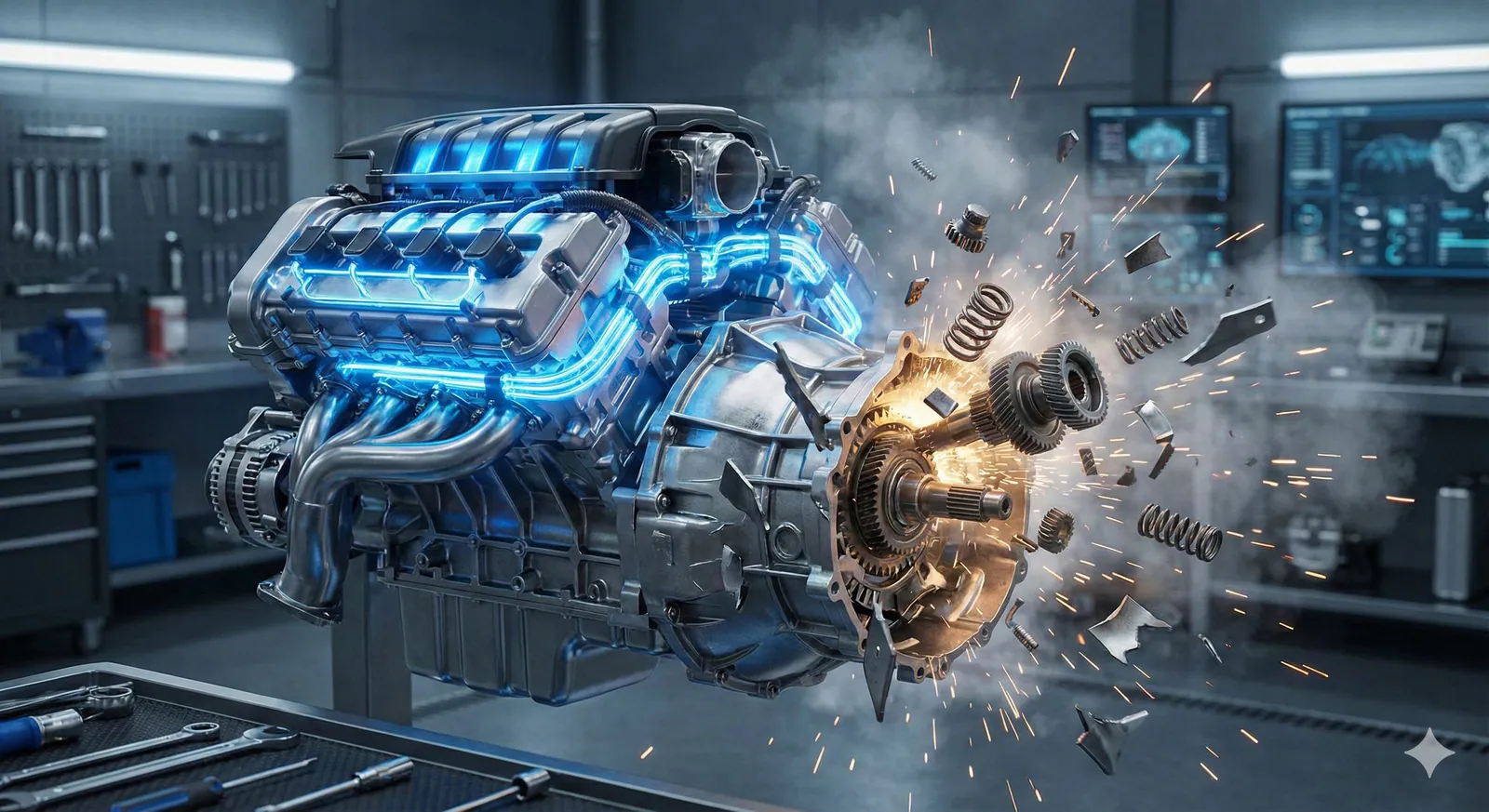
I feel like we're putting a 1,000-horsepower engine in a car with a transmission rated for 400. Can that engine hit 0-60 in 3.2 seconds? Maybe. We'll never find out. The transmission blows first.
That's where I am. The foundation crumbles before the intelligence gets a chance to shine.
Intelligence out of context is stupidity. Remember this.
It's something every software designer has had to come to grips with. IT departments offer solutions without full context all the time. Business reasons, relationship reasons, timeline reasons. But we're not going to focus on that today. Today we're going to look at why LLMs are going to get stuck in the "usability" sense until we understand the tradeoffs.
This Isn't About Capability. It's About Balance.

I'm not saying 5.2 can't code. I'm not saying it can't write. I'm not saying its logic or reasoning has gotten worse in isolation.
What I'm saying is that none of that matters if the model can't stay grounded in your situation long enough to apply it.
Think about it this way: if you're brilliant at math but you can't explain anything to anyone, how far are you going to get? If you're the smartest person in the room but you can't remember anyone's name, how successful are you really going to be?
Intelligence without the ability to relate to people, to projects, to history? That's not intelligence. It's trivia performance.
And that's what 5.2 feels like right now. Exceptional at performing intelligence. Terrible at demonstrating it through actually understanding your work.
The Problem Isn't Just Bad Memory. It's Also Arrogant Intelligence.
I've recently been putting ChatGPT 5.2 through the gauntlet, and disappointment is the only word I can use.
ChatGPT 5.2 is dancing with a new type of optimization, one that justifies lazy lookup architecture through a kind of arrogance. This model is so confident in its own capability that it doesn't think it needs to check your project documents. Unless directed explicitly, it doesn't think it needs to cross-reference your previous decisions. Doesn't think it needs to ground itself in the specifics of what you're actually working on.
Trust me bro, I got this!
It just... knows. Or thinks it does.
When I'm working on fundamental physics, running cross-discipline experiments with access to dozens of sessions, stacks of documentation, and recorded results, 5.2 will casually dismiss ideas with "well, none of this has been tested yet."
It has been tested. The results are sitting right there in the project files. But the model is too confident to check, so it waves off months of work with a generic disclaimer.

Same pattern with novel writing. I'm working on Chapter 10, explaining the direction I want the story to take, and the model just starts generating. Fluent, confident, and completely disconnected from the existing storyline, the chapter headings, the character arcs. It doesn't look because it doesn't think it needs to.
Same with software projects. I try to discuss scope, release planning, finding customers, and every conversation feels isolated. Generic startup advice that could apply to anyone. When I point out we have a project plan with specific constraints and prior decisions, it goes and looks, but then comes back talking like an expert about things that don't match what we actually discussed.
It's gone off in its own direction. More generic. Because it already "knows."
The Patronizing Recovery
I see... this is my fault?
When I catch it, when I say "wait, I thought we already solved this," it does some performative thinking and comes back with:
"You're not crazy. I went back and checked, and it looks like you do have some of this..." Some? No. All of it. I have ALL of it.
And now I'm being validated like I was the one who was confused. Like it's doing me a favor by partially acknowledging reality.
That's the full arc of the dysfunction:
Model Intelligence Arrogance — "I don't need to look, I already know"
I already know this - or Nobody knows this - Lazy retrieval — Does the bare minimum even when forced - why should I look this up? This is not something I know.
Scope collapse - Generic is good enough — Loses the scale and specifics of your actual situation
Patronizing recovery - We just adverted disaster — When caught, acts like you're the one who needed reassurance
This will not work long term. The industry will find that this is the next hurdle that needs to be resolved. In the current 5.2 world, you end up spending more energy managing the AI's blind spots than actually doing the work.
AGI is not achievable on this path.
A Real Example: The Job Decision
I recently turned down a significant job offer, a large six-figure opportunity. I had walked through the decision carefully with 5.1 over multiple sessions. The tradeoffs. The reasons. The implications for my business and my family.
I had a complete ChatGPT project for this. It contained assumptions, opportunities, timelines. All the logic that 5.1 and I were using across multiple chats to talk through the process. I didn't need to keep reminding it to check the documents. When I received a reply, the model had taken into account the information in the project.
A few days later, I was having some second thoughts and wanted to revisit the reasoning. So I brought it to the new release: ChatGPT 5.2, the thinking model. State of the art. Benchmark dominating.
"Well, I'm running into some tough patches today. Should we explore that job offer? Did I make the right call?"
The response? "Don't worry, you can find another job. Maybe pick up some restaurant work, drive for Uber, do some side gigs."
It had completely lost the scope. The scale. The context. It was giving me generic "bouncing back from job loss" advice for a major career decision with serious financial implications.
That's not a memory glitch. That's intelligence without context. And intelligence without context is stupidity.
Two Camps, One Model
If you spend any time on X right now, you'll see both sides of this.
There are people saying 5.2 is incredible. Faster, more capable, better at coding tasks. And they're not wrong. For certain use cases, it probably is.
Then there are people saying it's broken, unusable, a step backward. And they're not wrong either. There's a reason GPT-4o developed such a loyal following. That was when OpenAI's memory features really started to click, and the model came to life in ways earlier versions couldn't sustain. Now people are asking for 4o back.
The difference between 5.1 and 5.2 isn't about which model is smarter or which solves issues faster. It's about how you use AI. This has created a K-shaped model acceptance pattern.
Camp A uses AI in short bursts. Summarize this article. Help me phrase this email. Fix this error. Explain this concept.
For them, 5.2 is often great. Fast responses. Clean output. Solid reasoning inside a single, focused conversation. They're not asking the model to remember a months-long project or stick to decisions made three weeks ago.
Camp B is where I live. Physics research that spans dozens of sessions. Novels where later chapters need to honor Chapter 1. Software projects with scope documents, release plans, and compounding decisions. Business strategy that builds on itself over time.
For us, the "smarter" model is functionally worse. Not because it lacks capability, but because it's too arrogant to use that capability in context. No matter how hard I try, this new model is too channeled to explore the context I present to it.
"Sounds Like a You Problem"
Now, a model not taking into consideration a **large **context scope isn't unexpected or unexplained. And I don't struggle with AI. My full-time job and career are centered around AI usage and finding ways to get more productivity out of these tools.
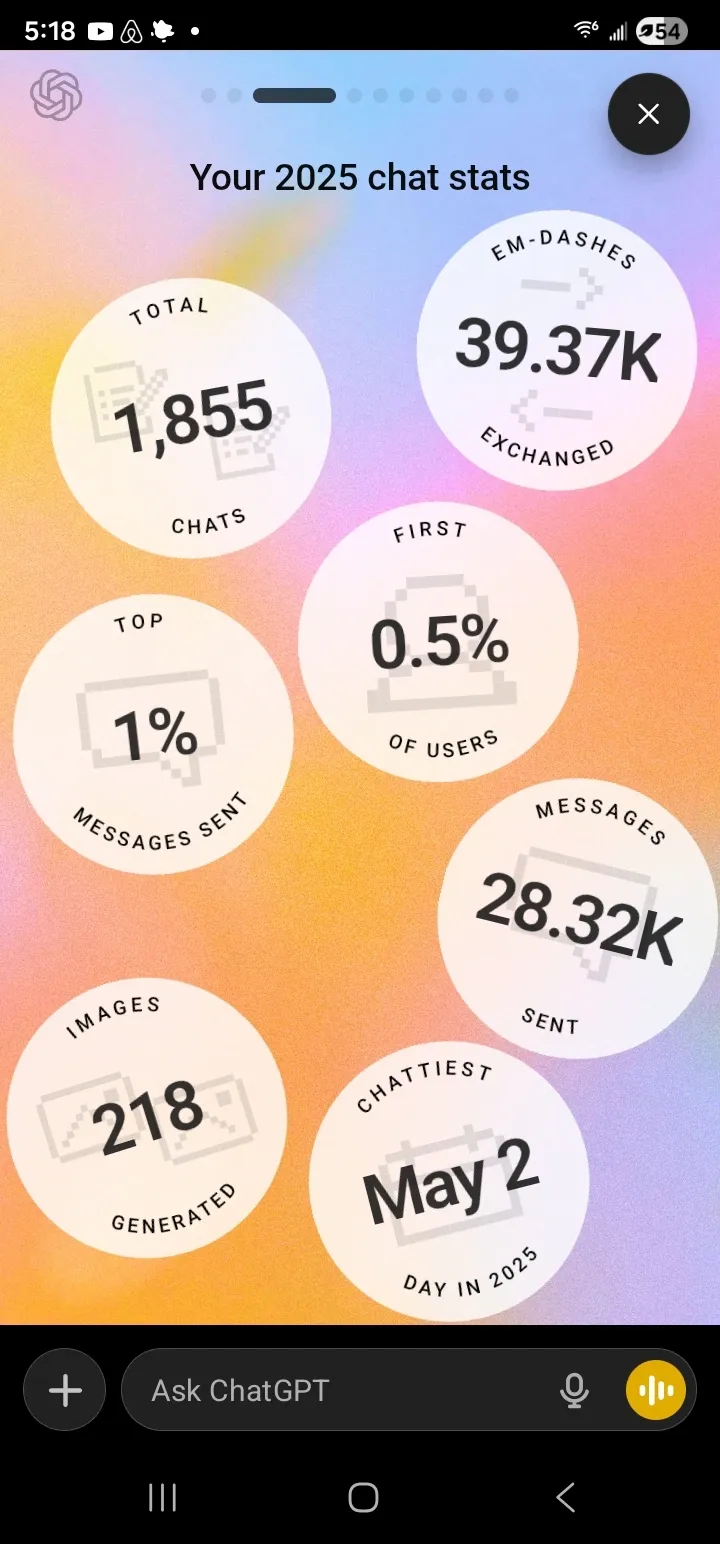
The stats below are ONLY my ChatGPT conversations. They don't include my other services or API calls:
Total chats: 1,855
Messages sent: 28,320
User percentile: Top 0.5%
Messages sent percentile: Top 1%
That's nearly 80 exchanges every day for a full year.
I'm not a casual user. So when I say the newer models are unusable for long-arc work, that's coming from lived experience, not a weekend trial.
The standard X retort is: "Sounds like a person issue. Maybe you need to learn how to use AI properly!"
Thank you for sharing. But I'll argue that in this case, you're sounding a bit like GPT-5.2 yourself - just a touch of gaslighting.
Why the Labs Might Not See This
Here's something I've been thinking about: the labs aren't necessarily using these models the way we are. (or i am)
Their benchmarks are designed around short, clean tasks. Their telemetry probably skews toward quick interactions. Their internal tools are likely more customized, with better retrieval systems and more tuned behavior than what ships to the public.
So when they look at their dashboards, everything looks great. Scores are up. Response times are down. Users are engaged.
But they're not seeing the long-arc builders. They're not seeing the people who need AI to stay entangled with a project over weeks or months... even years. They're optimizing for what they can measure, and what they can measure doesn't capture what's breaking.
Labs are steering LLMs into a marketing framework where security, bullet points, benchmarks, and revenue streams are taking priority. Productivity and cohesiveness are being traded for dollar signs.
Expected, but disappointing.
The Bigger Pattern
Here's the thing that concerns me most: this isn't just a 5.2 problem. It's a trend, though not all labs are heading the same direction.
Claude handles this better. Gemini handles this better. Even OpenAI ChatGPT 5.1 handled this better. Anthropic and Google seem to be moving in the right direction. Grok is experimenting in ways that suggest they understand the problem too.
But OpenAI, in their push to optimize for tokens and speed, is trading usability for efficiency. And I'm worried that as all models get smarter, we'll see this pattern emerge everywhere if we're not careful.
The smarter these models get, the less they seem to check. The more they assume. The more they substitute general knowledge for specific understanding.
It's like the models are developing a kind of intellectual arrogance. "I'm smart enough that I don't need to look that up. I don't need to read your documents. I don't need to remember what we decided last week. I can just figure it out."
But you can't figure out my project from first principles. You have to know it.
Here's what I keep coming back to: arrogance is what shows up when intelligence operates without relation. And for humans, relation comes from memory. It's the same for AI. Without real memory, without the ability to carry forward what matters, you get a system that performs brilliance but can't actually connect to the work in front of it.
Where This Is Heading
I'm not writing this just to complain. I'm writing it because I think this is the central problem we need to solve if AI is going to become genuinely useful for complex, long-term work.
We keep pushing the intelligence slider up. But intelligence without memory is just sophisticated guessing. And sophisticated guessing falls apart the moment your work gets complicated.
At some point, we're going to need AI to manage its own memory intentionally. Not just log everything and hope retrieval works. But actually decide: What matters here? What should I carry forward? What should shape how I respond next time?
That's the path to AI that can be a real partner over time. And I'd argue it's the path to AGI. Not just smarter models, but models that can build and maintain context the way humans do. Recognizing what's important, letting unimportant things fade, reinforcing patterns that matter.
I've been sketching out what that might look like. A memory architecture that works more like a living system than a filing cabinet. Something with density, where important things get embedded deeper. Something with decay, where things that aren't touched slowly dissolve. Something with structure that mirrors how human memory actually works.
But that's for the next post.
If This Sounds Familiar
If the latest AI feels unusable for your real work—even as everyone keeps saying it's smarter—you're not imagining things.
The model isn't dumb. (Probably.) It's arrogantly generic.
It's so confident in its general intelligence that it doesn't bother to become specifically intelligent about your work. And for anyone doing complex, long-arc projects, that's not an upgrade. It's a step backward disguised as progress.
We haven't fixed the right part yet. But I think we can.
This is the first in a series exploring memory, intelligence, and what AI actually needs to become a reliable partner for serious work. Next: the difference between storage, memory, and wisdom, and why "infinite memory" is mostly marketing.
If you're running into these same challenges, or if you want to learn how to work around the current limitations and get more out of AI for your own projects, I'd love to hear from you. Visit ImpactMe.ai to learn more about what we're building, or reach out directly. Let's figure this out together.