
The Great Compute Squeeze.
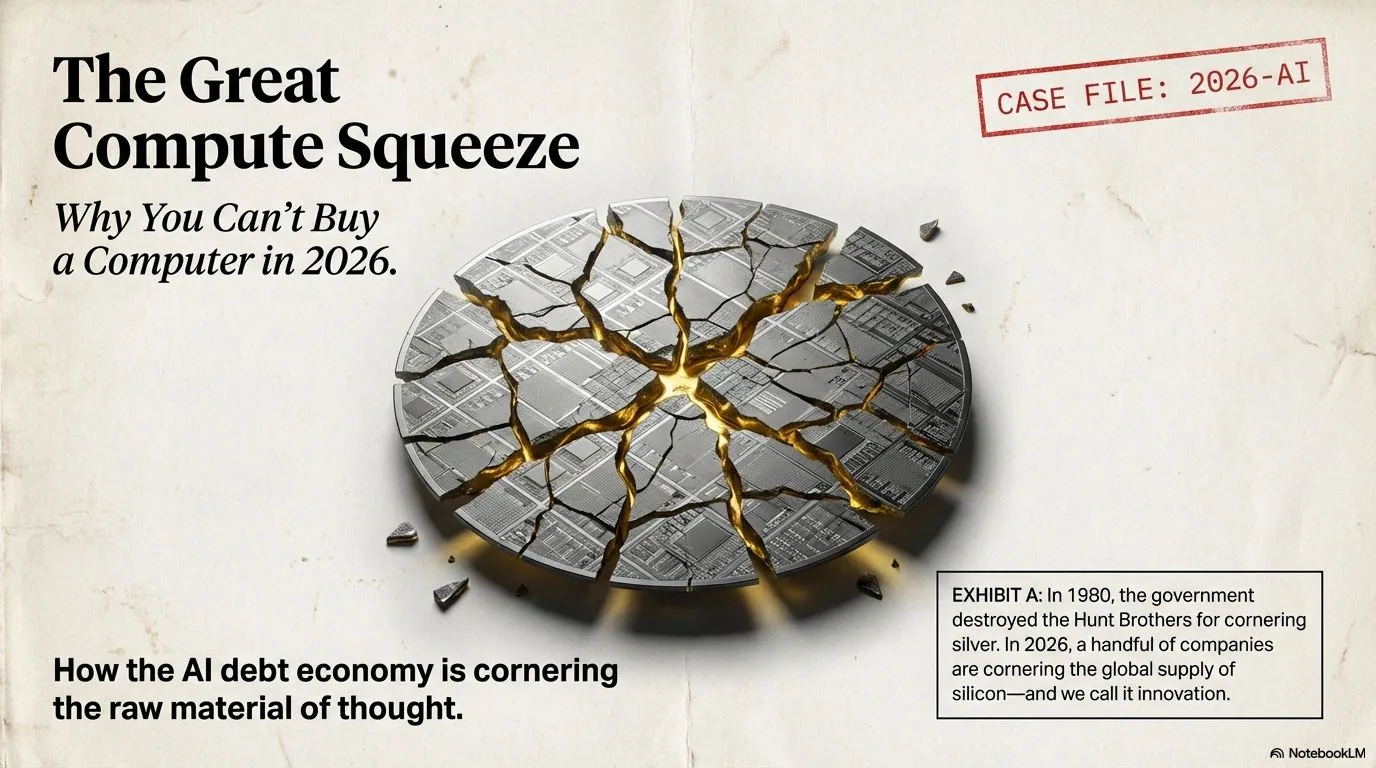
By Adam Murphy — impactme.ai - In 1980 the government destroyed two brothers for cornering silver.
It Was Illegal to Corner Silver. Cornering Thought Is Already Financed.
How the AI debt economy is doing to compute what the Hunt Brothers did to silver — and why nobody's stopping it.
Part 1: The Squeeze
By Adam Murphy — impactme.ai
In 1980 the government destroyed two brothers for cornering silver. But now... In 2026 a handful of companies are cornering the raw material of thought itself… and we're calling it innovation.
I need to put on my old tinfoil hat for a minute. It fits but it may not be needed.
For the record, I'm not anti-AI. I'm a former IT Director who teaches people how to use AI every day. I work and build with AI and I'm hopeful about the future potential with AI. But the hardware market right now is setting off every alarm I have.
The computer hardware rabbit hole means you're not just paying more for a laptop right now. You're watching yourself get priced out of owning any capable computer at all... so a data center can take your seat.
Stay with me because the data is real. The pattern is hard to unsee once you see it. And I'm not asking you to believe in a conspiracy. I'm asking you to follow the money. (Or debt as the case may be.)
The Hardware Is Disappearing
The numbers are wild, and they're all moving in the same direction.
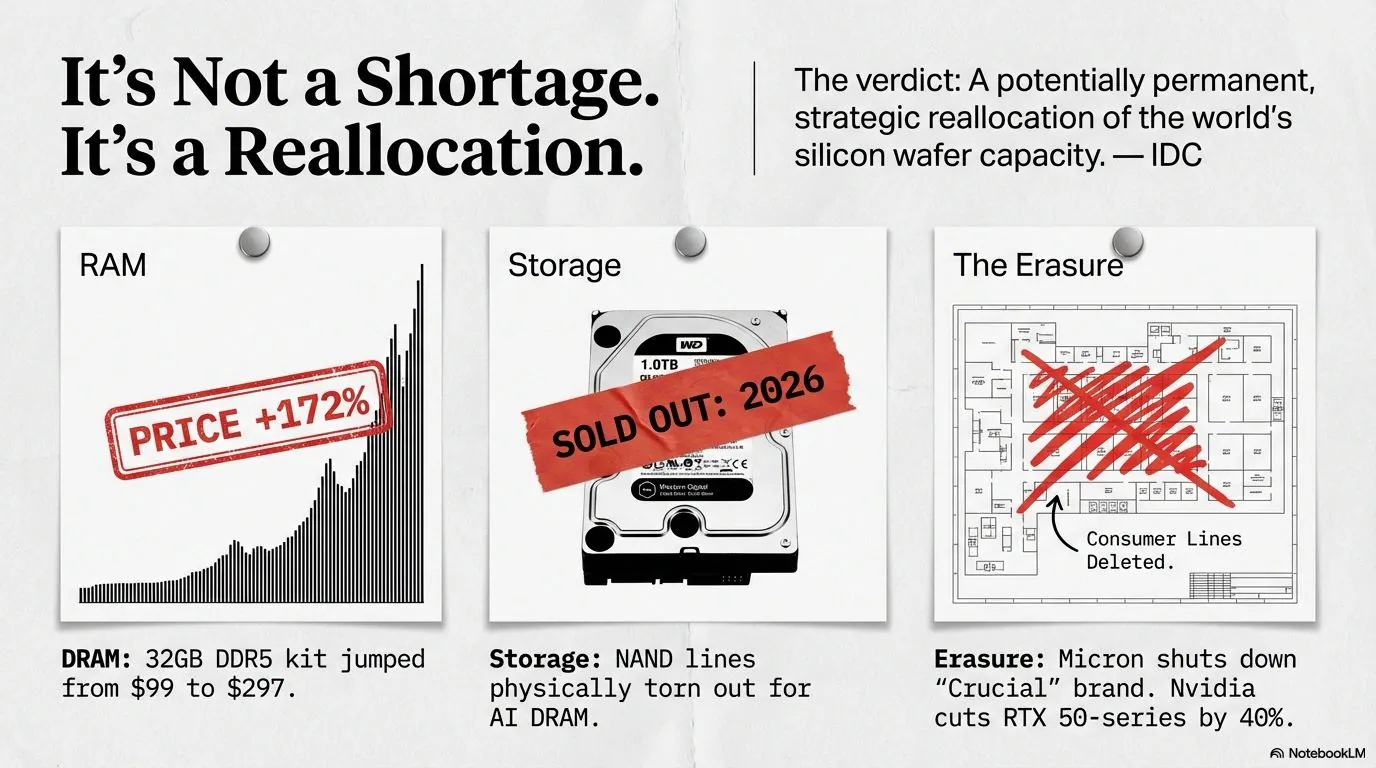
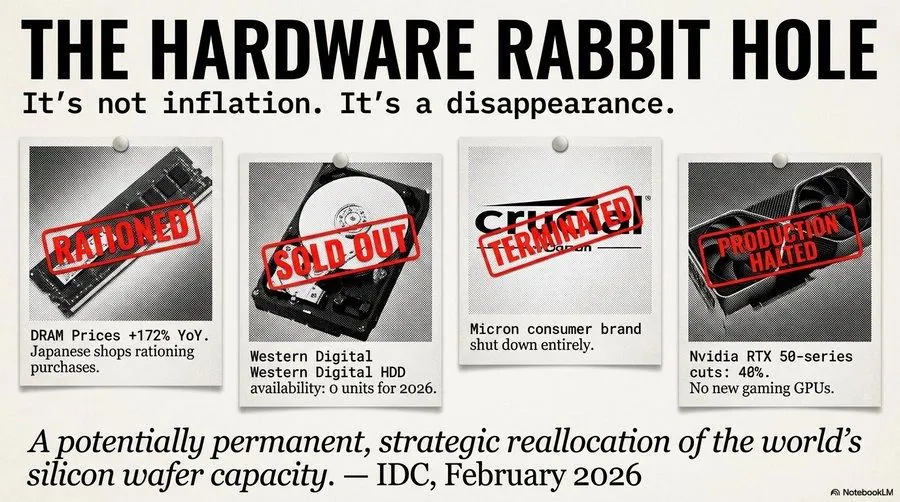
RAM: DRAM prices are up 172% year-over-year. DDR5 spot prices have quadrupled since September 2025. A 32GB DDR5 kit that cost $99 in March is now going for $297 from the same vendor. Micron has shut down its entire consumer memory brand — Crucial is just gone. Japanese electronics shops are limiting how much RAM you can buy per visit to prevent hoarding. IDC isn't calling this a normal cycle. They're calling it "a potentially permanent, strategic reallocation of the world's silicon wafer capacity."
That word — permanent — should concern everyone.
Storage: Samsung and SK Hynix are physically tearing out NAND production lines and replacing them with DRAM lines. Phison's CEO says all NAND production for 2026 is already sold out. Kingston is reporting a 246% increase in NAND wafer prices. Western Digital is sold out of hard drives — all of them — for all of 2026. PC manufacturers are already planning to ship laptops with smaller SSDs next year just to keep prices from going completely sideways.
GPUs: Nvidia is cutting RTX 50-series production by 30-40%. The RTX 40-series isn't being made anymore. AMD is raising graphics card prices at least 10%. Nvidia has said they won't release a new gaming GPU for the first time in three decades.
The common thread? AI data centers are consuming everything. OpenAI's Stargate project alone is projected to eat 40% of global DRAM output. Data centers will consume 70% of all memory chips produced in 2026. Every wafer that goes to an HBM stack for a data center GPU is a wafer that doesn't go into your laptop, your phone, or your desktop.
This isn't a shortage. It's a controlled reallocation of the planet's entire silicon supply.
The Pattern I Can't Unsee
Line it up:
RAM → can't buy it, or it costs 3x what it did a year ago
SSDs → sold out for 2026, prices doubling
Hard drives → Western Digital sold out through 2026
GPUs → production slashed, prices climbing
Consumer memory brands → being killed off entirely
Piece by piece, the components you need to build a capable computer are being removed from the consumer market. And the explanation is always the same: "AI needs it more."
Now think about what this country does when we don't want another country to develop advanced AI. We don't ban AI — we restrict the chips. We control the hardware, and the capability restriction follows naturally. That's the explicit strategy with China right now. Export controls on advanced semiconductors. Hardware denial as policy.
My question is simple: is the same mechanism operating on consumers, just using price instead of export law?
I don't think anyone needs to be in a room planning this. Samsung doesn't need a phone call from anyone to chase 3x margins on HBM over consumer DRAM. Cloud providers pre-buying years of supply drives prices up for everyone else without any coordination required. Each actor is making a rational business decision. But the combined effect is that regular people are being systematically priced out of capable hardware.
And the effect on you is the same whether it's planned or not.
The Quiet Part, Said Out Loud
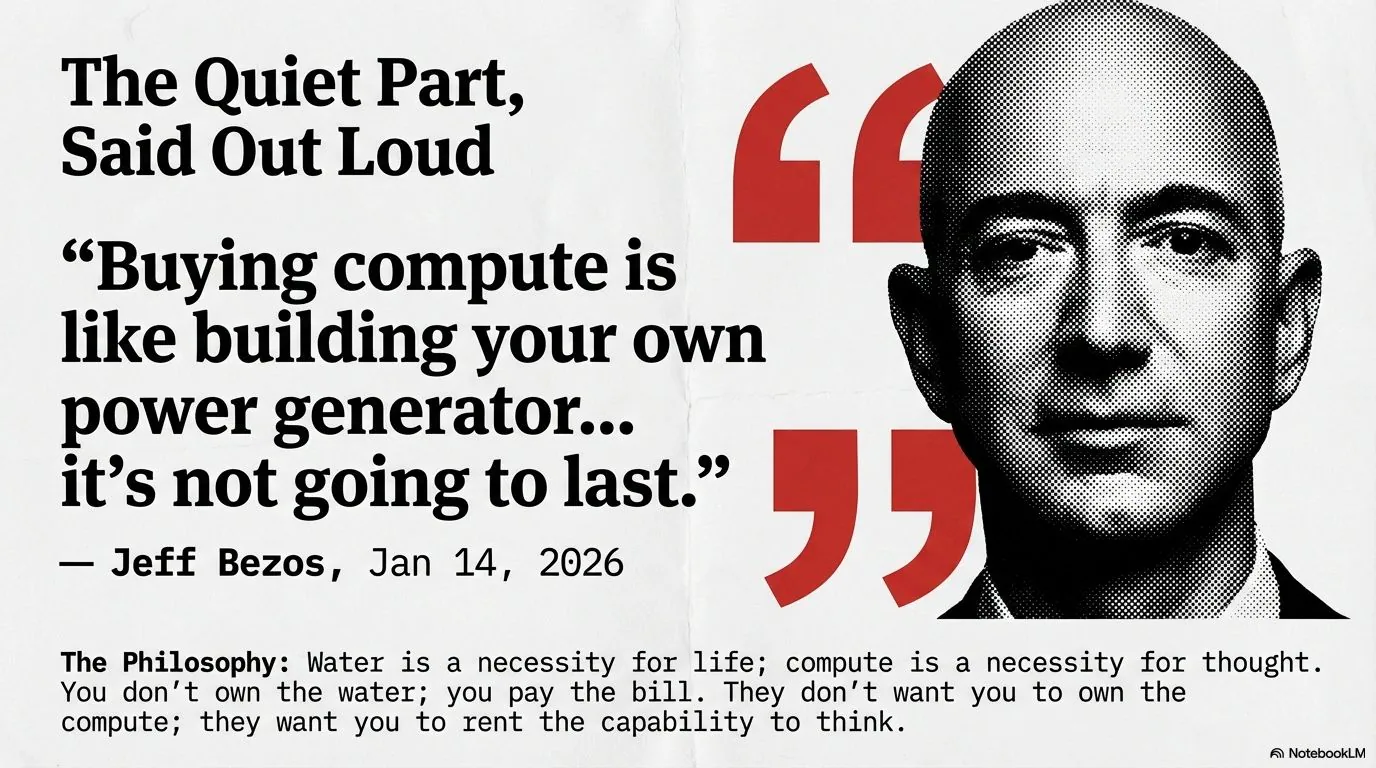
Jeff Bezos — the founder of the world's largest cloud computing company — gave an interview where he compared personal computers to the electric generators that breweries used to build before power grids existed. His argument was that owning your own compute "is not going to last." That you'll eventually "buy compute off the grid" from services like AWS.
Bezos revisited this theme as recently as January 14, 2026, at the New York Times DealBook Summit. He doubled down on the comparison, arguing that the current rush for every company to build its own private AI data center is a "massive waste of resources" and that eventually, even the biggest AI models will be "bought off the grid" like electricity.
Now, the charitable read is that Bezos is describing utility computing the way we transitioned from private wells to municipal water. And maybe that's true. But here's the difference: water is a necessity for life. Compute is becoming a necessity for thought. For how we work, create, learn, access information, and increasingly — how we earn a living. Handing that to a utility you don't control is a fundamentally different proposition than turning on a faucet.
And he's saying this at the exact moment when the hardware you'd need to prove him wrong is being priced out of reach.
HP has already launched laptop rental programs. Cloud gaming is being positioned as the answer to GPU scarcity. Microsoft's cloud desktops are being framed as the practical alternative.
Every "solution" being offered to the hardware shortage routes through a monthly subscription to someone else's computer.
Follow the Debt
Here's where it gets really uncomfortable. Because all of this infrastructure isn't being paid for with cash anymore. It's being financed. Leveraged. Borrowed. And the scale is staggering.
JP Morgan estimates that $5.3 trillion will be needed to support AI infrastructure through 2030. The top hyperscalers — Microsoft, Meta, Google, Amazon — spent over $800 billion in capital expenditure over the last five years, and they're projected to spend another $3 trillion from 2026 to 2030. But even companies with this kind of cash flow can't fund it all internally anymore. So they've shifted to debt.
In 2025 alone, AI-related companies tapped debt markets for at least $200 billion — and that's likely a significant undercount because many deals are private. Morgan Stanley expects $250-300 billion in issuance from just the hyperscalers in 2026. UBS is projecting up to $900 billion in new tech sector debt globally in 2026. Meta alone has raised $62 billion in debt since 2022, with almost half of that in 2025.
And they're getting even more creative about how they borrow:
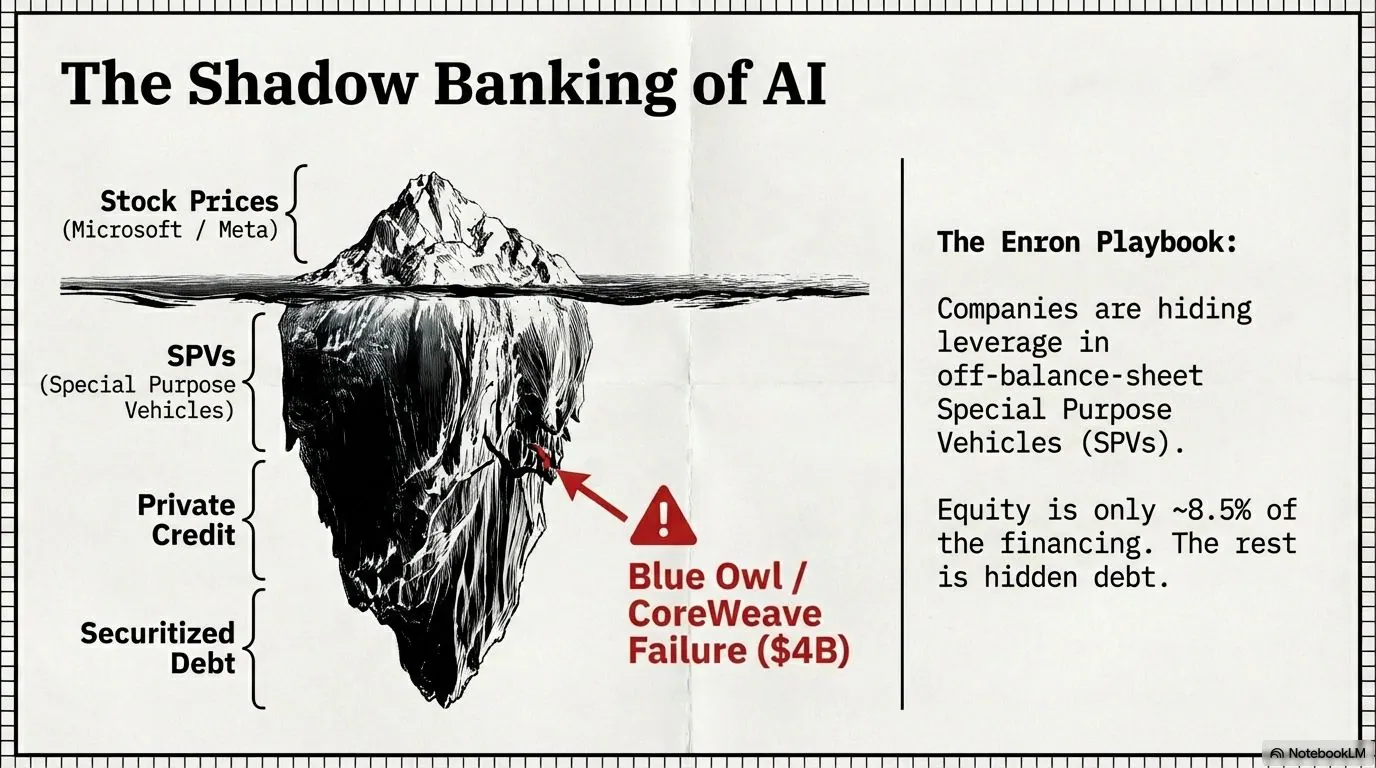
Private credit deals — Meta did a $27 billion joint venture with Blue Owl Capital, one of the largest private credit transactions ever. And Blue Owl? As of this week, they couldn't find lenders to fund a $4 billion CoreWeave data center project in Pennsylvania. Lenders passed, citing CoreWeave's junk credit rating. Blue Owl's stock has lost more than half its value in the past year, and they just had to sell $1.4 billion in loan assets to pension funds to return capital to investors. Mohamed El-Erian publicly asked whether Blue Owl is a "canary in the coal mine" — a nod to the Bear Stearns credit fund failures that preceded 2008. Treasury Secretary Bessent said he was "concerned" the risk had migrated to the regulated financial system. Nearly $200 billion in total debt was raised for data center development in 2025. Private credit is less transparent, less regulated, and harder to track than public markets.
Special Purpose Vehicles (SPVs) — Companies are setting up off-balance-sheet structures that let them build data centers without the debt showing up on their books. One analysis found that SPV structures are keeping an estimated $270 billion in debt hidden, with equity accounting for only 8.5% of the total financing. The rest is borrowed. If that sounds familiar, it should — off-balance-sheet vehicles used to hide the true scale of leverage is the same playbook that made Enron's collapse a surprise to everyone who wasn't reading the footnotes. Leverage doesn't disappear when you hide it. It just waits for the margin call.
Securitized debt — Data center loans are being sliced and packaged into CMBS and ABS products — the same kinds of instruments that fueled the 2008 financial crisis, just with data centers instead of houses. JP Morgan projects $30-40 billion per year in data center securitization for 2026-2027. This is how AI infrastructure debt ends up in your retirement portfolio whether you wanted the exposure or not.
High-yield bonds — CoreWeave, a cloud computing company that barely existed a few years ago, went public and immediately borrowed $3.75 billion in high-yield bonds at 9%, then another $2.25 billion in convertible bonds. Billions in debt for a company most people have never heard of — and now even Blue Owl can't find lenders willing to back their data center buildout.
All of this hardware being bought with borrowed money is getting concentrated in data centers that the average person has zero access to. It's not being distributed. It's being stacked in centralized facilities controlled by a handful of companies, financed by instruments that most people don't even know exist.
We Have Laws Against This — When It's Silver
In the late 1970s and early 1980s, two brothers from Texas — Nelson Bunker Hunt and William Herbert Hunt — used their family oil fortune and a mountain of borrowed money to buy up silver. Physical silver, futures contracts, everything they could get their hands on. They accumulated roughly one-third of the world's deliverable silver supply. Prices spiked 713% in a single year, from $6 to nearly $50 an ounce.
The Hunt brothers aimed to corner the silver market primarily to hedge against severe 1970s inflation, currency debasement following the end of the gold standard, and general economic instability. They believed silver was fundamentally undervalued and preferred tangible assets over paper currency. Whether they were right about that has become more interesting lately — just this past January, evidence of suppressed silver pricing has resurfaced, suggesting the Hunts may have been seeing something the market didn't want acknowledged.
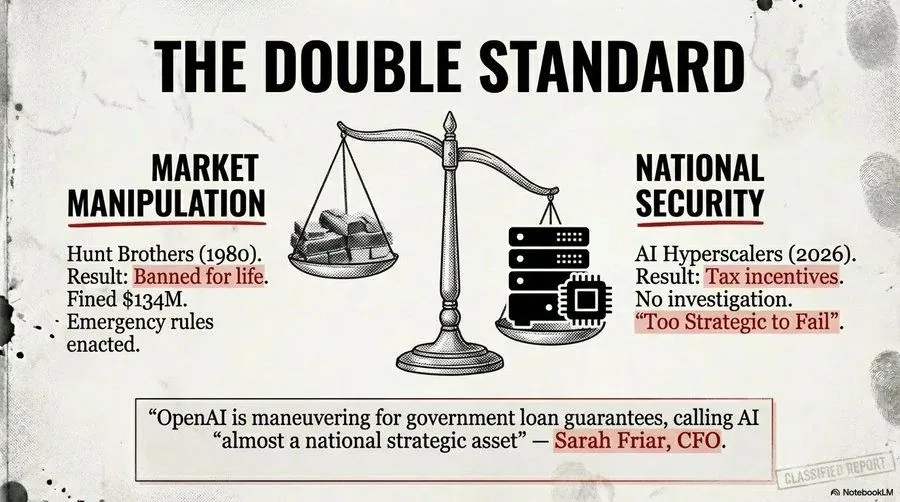
But the response in 1980 was swift and absolute. COMEX created emergency rules restricting margin purchases. The CFTC investigated. Tiffany's took out a full-page ad in the New York Times calling it "unconscionable for anyone to hoard several billion dollars' worth of silver and thus drive the price up so high that others must pay artificially high prices." A federal jury found the brothers guilty of conspiracy to corner the market. They were ordered to pay $134 million in damages, fined $10 million each, and banned from commodity trading for life.
Two guys tried to corner silver on leverage, and we shut it down, prosecuted them, and wrote new rules to prevent it from ever happening again.
Now look at what's happening with compute:
A handful of companies are consuming 70% of global memory chip production
One project alone — Stargate — is absorbing 40% of global DRAM output
DRAM prices have spiked 172% — and rising, potentially hitting the same scale as the Hunt brothers' silver manipulation
This is being financed with hundreds of billions in borrowed money, private credit, off-balance-sheet vehicles, and securitized debt
Consumer brands are being shuttered, production lines physically dismantled, and supply redirected entirely to serve these buyers
The result is an artificial scarcity that is pricing ordinary people out of essential hardware
And the government's response? Not investigation. Not regulation. Not emergency market rules. Instead, AI infrastructure has been designated a national security priority, which means the hoarding isn't just permitted — it's subsidized and encouraged.
When the Hunt brothers cornered silver, we called it market manipulation and put them on trial. When a handful of tech companies corner compute — the commodity that underlies how modern society thinks, works, and communicates — we call it progress and hand them tax incentives.
I'm not saying these are legally identical situations. Commodity futures markets have specific regulations that don't directly apply to semiconductor purchasing. But the effect on ordinary people is the same: a small number of actors, using enormous leverage, are hoarding a critical resource, driving prices beyond what regular people can afford, and reshaping the market in ways that benefit themselves at everyone else's expense.
I do not want to be the judge...
Here's what makes me think about the Hunts differently now. They were doing it because they believed the price wasn't being treated fairly and they wanted to expose it — or force the market to acknowledge it. Maybe that's what the AI companies think too. This isn't valued fairly; we'll buy it all up until it is. The difference is that the Hunt brothers were cornering a commodity you can work around. These companies are cornering the foundation of the digital economy.
The Bailout Trap
Now follow the dominoes.
Your retirement is already exposed. The Magnificent Seven — Apple, Microsoft, Nvidia, Alphabet, Amazon, Meta, Tesla — make up roughly a third of the S&P 500 as of February 2026. In 2025, approximately 42% of the S&P 500's total return came from these seven stocks alone. If you have a 401(k), a pension, an IRA, or any index fund — you're already heavily invested in the companies doing the AI spending. Vanguard and Fidelity have started updating their disclosures to warn investors about "non-diversification risk." Your retirement is an AI bet whether you chose it to be or not.
And it's not just the equity side. All that data center debt is flowing into the fixed-income side of portfolios too. So both halves of a traditional retirement portfolio are getting loaded with AI exposure.
If the ROI doesn't materialize, the crash hits everyone. What happens if most companies can't actually monetize AI at the scale needed to service trillions in infrastructure debt? Meta's own 10-K filing admits there's "no assurance that the usage of AI will enhance our products or services." You get a correction that doesn't just hit tech stocks — it hits the index funds your 401(k) is built on. It hits the bond funds holding data center debt. It hits the pension funds that invested in private credit deals.
The bailout comes out of your pocket. We saw the playbook in 2008. Institutions holding this debt become "too big to fail." Taxpayers cover the cleanup. And while you're absorbing that cost — through taxes, through inflation, through energy costs, through lost retirement value — you still can't buy a computer, because the hardware supply was already redirected away from the consumer market.
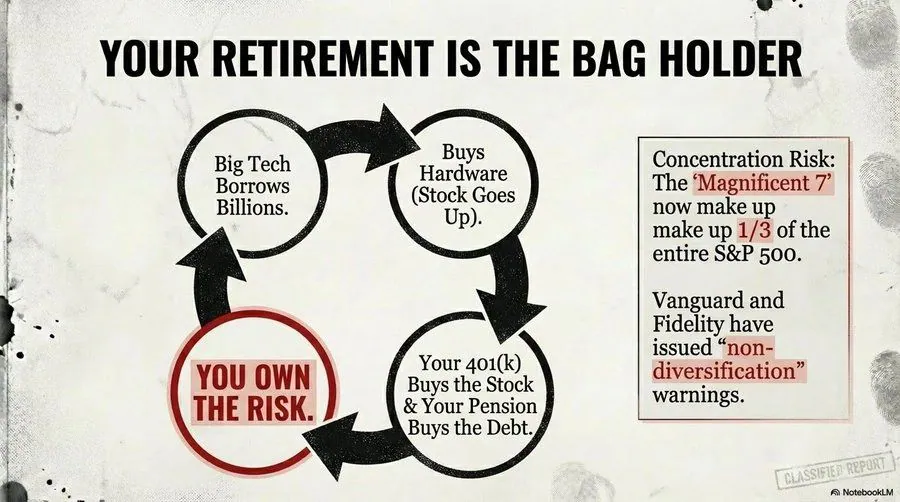
You pay for the bubble on the way up (through inflated hardware prices) and on the way down (through bailouts and portfolio losses). Either way, regular people lose.
The monopoly lock-in. Now here's the cynical piece. Let's say the crash doesn't happen. Let's say AI does generate returns — how? Only if these companies convert every possible user into a subscriber. The only way to service trillions in debt is recurring revenue at massive scale. And the only way to guarantee that recurring revenue is if people have no alternative.
Imagine if someone bought up all the bricks in the world to build a massive commercial building — and simultaneously made sure wood became unavailable for anyone else to build their own house. You wouldn't say "nice building." You'd recognize they created artificial scarcity so you'd have no choice but to pay rent.
That's what's happening with compute. If you can't buy a computer that runs AI locally, you must subscribe. If your employer replaces your role with an AI agent running in a data center, you don't get a PC to work with anyway. If the narrative becomes "personal computers are unnecessary because AI handles everything through the cloud" — then the market for consumer hardware disappears, and the monopoly becomes self-reinforcing.
They don't even need to ban personal computers. They just need three things to happen simultaneously:
Hardware stays unaffordable long enough for the consumer market to shrink
AI replaces enough jobs that fewer people "need" a PC
Cloud subscriptions become the default way everyone accesses compute
At that point, they'll argue they're providing an essential service. They'll say "we invested trillions to build this infrastructure, and now we need to recoup those costs." And they'll be the only game in town.
And if you think a government backstop is off the table — OpenAI's own CFO, Sarah Friar, floated the idea of government-backed loan guarantees at a Wall Street Journal conference in November 2025, calling AI "almost a national strategic asset." Sam Altman walked it back publicly, saying OpenAI doesn't want government guarantees for its data centers. But a letter OpenAI sent to the White House just weeks earlier explicitly called for "grants, cost-sharing agreements, loans, or loan guarantees to expand industrial base capacity." Senator Elizabeth Warren sent Altman a letter demanding answers about the gap between what he says publicly and what OpenAI lobbies for privately. The American Prospect ran a piece titled "OpenAI Is Maneuvering for a Government Bailout."
The ask is already on the table. Whether it gets approved is just a matter of timing.
The Counter-Narrative (And Why It Doesn't Help)
Now, in fairness, let's examine the bull case. Maybe centralized AI compute leads to a post-scarcity intelligence age. Maybe everyone benefits from cheaper, more powerful AI delivered through the cloud. Maybe the efficiencies are real and the democratization happens from the top down.
Even if all of that is true — the toll road is being built by the people who already own the asphalt. And the price of entry is your independence.
We've seen this before. In the 1990s, telecom companies laid 80 million miles of fiber optic cable — $500 billion worth, mostly financed with debt, backed by favorable tax treatment, government-approved rate increases, and deregulation designed to encourage the buildout. When the bubble burst, 85-95% of it sat unused — "dark fiber." Eventually that fiber became the backbone of the 2010s tech boom.
But did consumers actually win? That fiber wasn't bought by regular people. It was scooped up for pennies on the dollar by the institutional survivors — the banks and the telecoms that made it through. Instead of a democratized internet utopia, we got locked into regional telecom monopolies. Today, the average American pays $68 a month for broadband — more than double what consumers pay in Germany, triple South Korea, and multiples above almost every other developed country on Earth.
If the AI data center bubble pops, the same thing happens. The hardware doesn't disperse into the economy. It gets bought at auction by the same class of institutions that funded the bubble. And if it doesn't pop, the monopoly locks in.
Either way, distributed compute loses.
What Now?
That's a lot of dominoes. And I'll be honest — I was hoping the data would talk me down.
It didn't.
In Part 2, I'm going to talk about what I'm actually doing about it. What local compute sovereignty looks like in practice, what the options are at different price points, how to think about the risk and reward of owning your own hardware, and why this isn't just a tech decision — it's a financial one, a strategic one, and maybe a moral one too.
Because I don't know if this is a two-year squeeze or a permanent structural shift. But I don't think it's getting cheaper, and I'm not going to sit around and find out.
[Read Part 2: Building Digital Sovereignty — A Multipronged Approach →]
Adam is the founder of impactme.ai, where he teaches people to use AI as a thinking partner — not just a content generator. He's a former Fortune 500 IT Director who builds things, breaks things, and occasionally puts on a tinfoil hat when the data calls for it.
Sources
IDC: "Global Memory Shortage Crisis: Market Analysis and the Potential Impact on the Smartphone and PC Markets in 2026" (February 2026)
Wikipedia: "2024–present global memory supply shortage"
Tom's Hardware: RAM Price Crisis Live Tracker; GPU Price Tracker 2026
Tom's Hardware: "Western Digital is already sold out of hard drives for all of 2026" (February 2026)
Tom's Hardware: "The RAM pricing crisis has only just started, Team Group GM warns" (December 2025)
Tom's Guide: "'That's not going to last': Jeff Bezos believes AI will force you to rent your PC from the cloud" (January 2026)
Windows Central: "Jeff Bezos said the quiet part out loud" (January 2026)
Brian Haman, PhD: "AI Centralization and the Collapse of Consumer Computing" (December 2025)
Computer Weekly: "Chip makers warn of a looming shortage in DRAM and SSD" (2025)
TrendForce: "NAND Flash Dry Year" analysis (December 2025)
Bloomsbury Intelligence and Security Institute: "Global RAM Shortage and Price Hikes" (January 2026)
Bank for International Settlements: "Financing the AI boom: from cash flows to debt" (2026)
iCapital: "Data Center Infrastructure: Moving from Cash to Debt" (December 2025)
Yahoo Finance / Bloomberg: "The $3 Trillion AI Data Center Build-Out Becomes All-Consuming For Debt Markets" (February 2026)
Mellon Investments: "Record-Breaking AI-Related Debt Issuance in 2025"
Ernest Chiang: "Off-Balance Sheet AI: How SPVs Are Financing the Data Center Boom While Hiding Leverage"
S&P Global Ratings: "Liquidity Outlook 2026" (February 2026)
Motley Fool: "The Magnificent Seven's Market Cap vs. the S&P 500" (February 2026)
Fortune: "How the Magnificent 7 destroyed index funds" (February 2026)
InvestmentNews: "Advisors confront Magnificent 7 concentration risk in portfolios" (January 2026)
Wikipedia: "Silver Thursday" — Hunt Brothers attempt to corner the silver market (1979-1980)
Britannica: "Silver Thursday" — dramatic fall in silver prices, March 27, 1980
Priceonomics: "How the Hunt Brothers Cornered the Silver Market and Then Lost it All"
APMEX: "Silver Thursday: The Hunt Brothers Scheme"
Bisnow: "Blue Owl Denies Report Of Financing Issues On $4B CoreWeave Project" (February 20, 2026)
CNBC: "Blue Owl's software lending triggers another quake in private credit" (February 20, 2026)
Reuters: "Blue Owl Shares Drop Again as Asset Sale, Debt Fund Changes Fan Investor Worries" (February 20, 2026)
Investing.com: "CoreWeave's B+ rating leads to Blue Owl's failed $4bn data center financing" (February 2026)
Bloomberg: "Blue Owl Sold Loans to Pensions, Own Insurance Asset Manager" (February 20, 2026)
TechCrunch: "Sam Altman says he doesn't want the government to bail out OpenAI if it fails" (November 6, 2025)
NBC News: "OpenAI's Sam Altman backtracks on CFO's government 'backstop' talk" (November 7, 2025)
The American Prospect: "OpenAI Is Maneuvering for a Government Bailout" (November 7, 2025)
Senator Elizabeth Warren: Letter to OpenAI regarding government subsidies (January 28, 2026)
S&P Global: "Americas Broadband Roundup, 2025" — U.S. average broadband at $68/month (November 2025)
TodayTesting: "Internet Speed vs Cost by Country (2026)" — U.S. ranks 6th most expensive globally
Milken Institute Review: "The Scandalous Cost of Internet in America"