
We Don't Have a Spreadsheet Problem
Part 1: The Cascade
Part 1 of 3 — A series about what AI is actually doing to the economy, and we are not asking the right question. - I intend this to be my perspective from my seat.
I left my job as an IT Director at a Fortune 500 company to go play with AI. Not to "start a business," exactly — though I've done that too. I left because I could see something coming that most people couldn't, and I wanted to understand it before it arrived.
What I've learned in the months since has not changed my original thesis. Things in the AI world are changing at exponential speed. And the implications are so much bigger than most are talking about.
Let me show you what I mean.
One App, One Industry, One Domino
I built a tool called LenderSpark. It's a CRM/Automation tool designed for mortgage lenders, it helps them manage clients, track loans, stay organized. Pretty straightforward.
Here's what happened when I started thinking through what AI does to the lending industry. Not in theory. In practice. One domino at a time.
Right now, if you want to buy a home, you go to a lender. The lender shops around to banks. The banks have teams of people reviewing your application — underwriters, compliance officers, analysts. Everyone's checking criteria, reviewing documents, making decisions. It's a chain, and every link in that chain is a person with a salary.
Now imagine an AI that can do what LenderSpark does, but better. It manages the client relationship, it searches for the best rates across banks, it handles the paperwork, it checks compliance. Suddenly, you don't need the lender in the middle. You just go straight to the tool.
But wait — the banks have the same idea. Why do they need all those employees reviewing applications when AI can evaluate borrowers faster and more accurately than a human team? So the bank automates its underwriting. Now you've got an AI tool talking to an AI bank, and the entire human chain in between just... compressed.
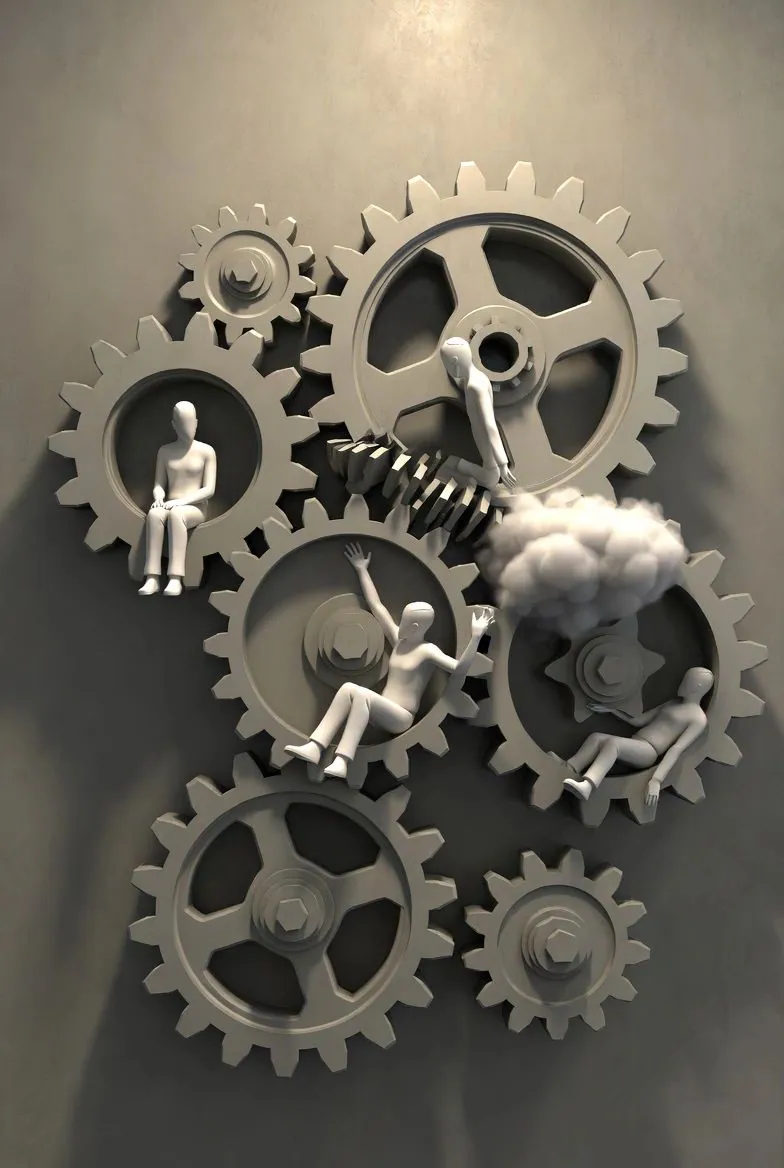
And it gets worse. Because the person trying to buy that house? They have a job. They earn a salary. That salary is what qualifies them for the mortgage. But what's their job? Chances are, it's something AI is coming for too.
That's the cascade. It's not that AI replaces one job. It collapses entire chains of value simultaneously. The lender, the bank employee, the underwriter, the compliance officer, and eventually the buyer's job itself. One domino tips and the whole line goes down.
The Second Best One Is Free
Here's the part that the AI companies don't want to talk about.
While I was writing this, a Chinese AI startup called MiniMax released a model called M2.5. It scores within a fraction of a percent of Anthropic's top model — Claude Opus 4.6 — on the benchmarks that matter most for real-world coding and agentic work. It matches Opus on speed. It handles full-stack development across multiple platforms. And it costs about a twentieth of the price. One dollar per hour of continuous use. You can run four of these things around the clock for an entire year for ten thousand dollars. The model that took Anthropic years and billions of dollars to build... a startup in Shanghai just matched it for pocket change. Oh, and it's open source. Anyone can download it and run it themselves for free.
This past week, half the founding team at xAI — Elon Musk's AI lab — quit. One of them, a machine learning researcher, said something on his way out that stopped me cold: "All AI labs are building the exact same thing, and it's boring."
I see it, and now a person inside one of the most well-funded AI labs on the planet just said they're all converging on the same product.
Meanwhile, Anthropic's head of AI safety resigned with a letter that basically said the world is in peril and we don't have the wisdom to handle what we're building. And another xAI co-founder said "recursive self-improvement loops likely go live in the next 12 months."
So here's the question nobody's asking: if all the AI models are converging, and the best one costs money, but the second-best one is free or next to free... how does anyone make money selling AI?
You might use or run on the state-of-the-art, best-trained model in the world. But the one in second place is 95% as good and costs next to nothing. How much are you going to pay for that last 5%?
This isn't just a problem for AI companies. It's a problem for everyone building on top of AI. Because whatever you build today, in six months there's going to be a tool that does it automatically. That six months of work you put in? Someone who was behind you by six months downloads the new app and they're caught up overnight.
I've been calling this the six-month treadmill. You're running as fast as you can, but the ground keeps resetting behind you.

The Experts Are Getting This Wrong
Most of the experts talking about AI are answering the wrong question. They're asking "which jobs will AI replace?" as if it's a list you can plan around. Avoid these five careers. Pivot to these three. Here's how to be AI-proof.
** But that is not how this works.**
When you collapse one link in a value chain, you don't just eliminate that one job. You change the economics for every job connected to it. The lender's job doesn't just disappear — the lender's clients lose their reason to exist. The bank's employees lose their function. The entire ecosystem shifts, and no one saw it coming because they were only looking at one link at a time.
I'm not an expert in the pundit sense. I don't appear on panels or publish papers about AI policy. What I am is someone who left a stable successful career to use AI eight to twelve hours a day, every day, building real things across real industries. I don't answer phone calls between AI sessions. I don't check AI between meetings. I just build.
And from that vantage point, the view is very different from what the experts are describing.
The experts attend conferences. I watch the tools change week to week. The experts compare benchmarks. I watch entire product categories become obsolete between updates. The experts debate timelines. I watch timelines get blown past while they're still debating.
So What's Actually Happening?
Here's what I think is happening, and I want to be honest about the fact that nobody - including me - knows exactly how this plays out.
Every industry has a chain. Raw materials to processing to distribution to sales to support. Every link in that chain is currently held by a person or a team. AI is learning to do what every one of those links does, not sequentially but in parallel. It's not replacing the cashier then the manager then the supply chain analyst. It's coming for all of them at roughly the same time.
And it's accelerating. The gap between "AI can kind of do this" and "AI does this better than you" is shrinking from years to months. The CBO just projected a $3.115 trillion deficit. OpenAI just launched a model that processes over a thousand tokens per second. Those two facts aren't unrelated — the economy is straining while the technology that disrupts it keeps getting faster and cheaper.
I don't say this to scare anyone. I say it because I think most people deserve a clearer picture of what's coming so they can start thinking about it honestly.
And here is that question...
If AI can do everything you do for a living... what are you actually for?
Please not see that as a depressing question. I think it might be the most important question anyone alive right now can ask. And I think the answer is a lot more hopeful than you'd expect.
But that's Part 2.
Next: Part 2 — The Squeeze. What happens when jobs disappear but bills don't?
This is Part 1 of a 3-part series. Parts 2 and 3 are coming over the weekend.
I'm Adam, founder of impactme.ai. I help people and businesses learn to work with AI — not because it's trendy, but because I think it's the most important skill anyone can develop right now. If any of this resonated, come say hi.