
We Don't Have a Spreadsheet Problem - II
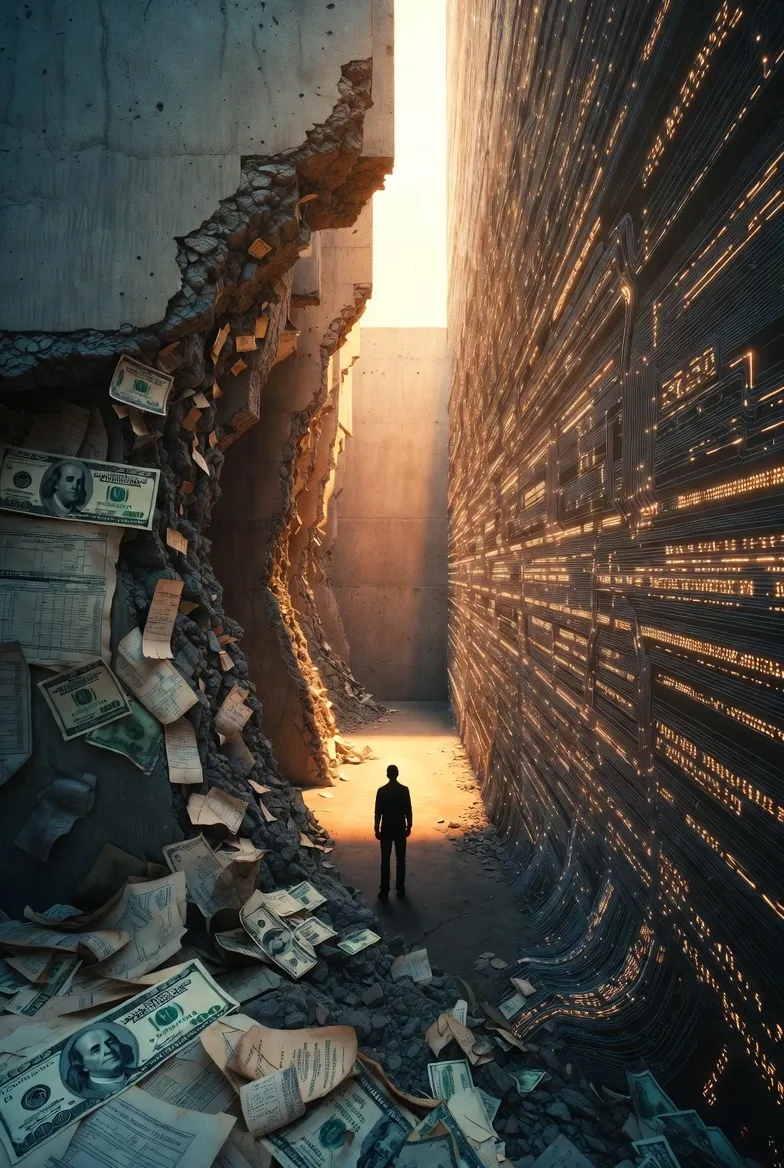
Part 2: The Squeeze
Part 2 of 3 — What happens when jobs disappear but bills don't.
In Part 1, I walked through something I call the cascade and how AI doesn't just replace one job, it collapses entire chains of value at the same time. The lender, the bank, the underwriter, and eventually the buyer's job itself. One domino tips and the whole line goes.
Now I want to talk about what happens in the middle. Not the end state... but out middle state... I actually think the end state might be beautiful. But today I'm talking about the part between here and there. The part where things very well could get ugly.
The Math That Doesn't Math
A budget office should be decent with math right?
The Congressional Budget Office just projected the U.S. deficit will hit $3.115 trillion. Not the debt — the deficit. That's how much more we're spending than we're taking in, in a single year. The total national debt is pushing $38 trillion, and we've got a mountain of that debt coming up for refinancing this year.
Now, the government pays for things with taxes. Taxes come from income. Income comes from jobs. But we just spent all of Part 1 talking about how jobs are being compressed, automated, and cascaded out of existence.
See the problem?
The system that funds the government requires a workforce that's getting smaller. The debt that the government owes requires growth that depends on that same shrinking workforce. And the interest on that debt keeps climbing even when the Federal Reserve tries to push rates lower — the bond market isn't cooperating.
We are, as a nation, writing checks against a future that may not have the jobs to cash them.
And it's not just the government. Every mortgage, every car payment, every student loan, every credit card balance - they are all built on the assumption that you're going to keep earning what you're earning. The whole consumer economy is a bet that tomorrow looks roughly like today.
AI is making that bet increasingly risky.

The Six-Month Treadmill Gets Personal
Let me bring this down from the abstract to the personal. This is what I feel daily.
Say you're a web developer. Today, you're good. You've got skills that people pay for. But have watched AI go from "it can kind of write basic code" to "it built me a full application in an afternoon" in less than a year. Not in theory — I watched it happen on my own screen.
So you learn the new tools. You adapt. You're now an AI-assisted developer and you're twice as productive. Great. But here's the next catch. . . so is everyone else. And some of them were half as good as you before, but the AI brought them up to your level. The tools bridge the skills gap. The talent pool just expanded and leveled out simultaneously.
Six months later, the tool doesn't need a developer at all. The client just describes what they want and the app builds itself. That six months you spent learning the new framework? Someone who wasn't even in the field yesterday just got the same result by talking to a screen.
That's what I mean by the treadmill. You're running. You're adapting. You're doing everything right. And the ground is resetting behind you.
Now multiply that across every knowledge worker in the economy. Attorneys, accountants, analysts, marketers, consultants, project managers, customer service, HR, even entertainment. The timeline varies, but the direction doesn't.
The Valley Between Worlds
It's not that the jobs go away. It's the timing.
The cost structure of your life was built in the old world. **Mortgage **— signed in the old world. Car payment — old world. Insurance premiums, grocery prices, property taxes — all priced for an economy where your job exists and your salary holds.
But your income is being compressed by the new world. AI is deflating the value of what you do, even if it hasn't eliminated your specific job yet. And this is not a surprise, but the people who own the infrastructure, the banks, the landlords, the insurance companies — they have every incentive to keep prices where they are, even as your ability to pay drops.
Costs are sticky. Income is not. Salary goes up when the MUST and they come down as soon as they can.
That's the squeeze. You're caught between a cost structure that refuses to drop and an income that's being compressed from above. And the squeeze doesn't care whether you adapted, learned new skills, or bought the right course. It's structural, not personal.
I'm not predicting some dramatic collapse- at least, I hope not. But I am saying that the space between "my job still exists" and "the world has fully adjusted to AI" could be a really uncomfortable place for a lot of people. Five years. Maybe ten. That's a long time to be caught in the valley. How long will society be in the middle ground? I feel it is connected to our debt.
Where the Money Goes When the Money Breaks
This is where things get interesting - and where I'll be honest that I'm thinking out loud, and not claiming certainty.
If the government can't collect enough taxes to service its debt, and it can't cut spending fast enough to balance, the most likely move is what governments have always done: print money. Inflate the currency. Quietly make the debt smaller by making the dollar worth less.
That works — sort of — until people notice. And people are starting to notice.
On the same day I watched the AI news rolling in, my feed showed me a post about 4 million ounces of physical silver being drained from the COMEX in a single day. People are pulling real metal out of the paper system. That's not a meme. That's a signal. It's people saying, "I don't trust the paper anymore. I want something I can hold."
The digital economy is deflating. AI capability is racing toward zero cost. The physical economy might be about to inflate. Real resources, real materials, real scarcity — those could get more expensive even as digital services get cheaper.
Those two forces — digital deflation and physical inflation — are squeezing toward each other. And anyone caught in the middle with a salary that's being AI-compressed and a cost of living that's being resource-inflated... that's where the pain lives.
I don't know exactly how this resolves. Maybe it's a new currency. Maybe it's a return to hard money. Maybe blockchain solutions. Maybe it's something nobody's thought of yet. Maybe it's messy and slow and we just grind through it the way humans always have. But** I do think **anyone who's paying attention should at least be aware that the current system is running on math that no longer works.

The Bridge Problem
So if the old system is breaking and the new system isn't ready, what do people actually do?
Every expert I hear talking about AI has some version of the same advice: upskill, reskill, learn to work with AI, become the person who manages the robots. And look — that's not wrong. That's literally what I teach. It's real and it's useful and people should do it.
But it's also incomplete. Because it assumes the economy stays structured roughly the same way — that there will still be employers hiring humans who have AI skills. And I think that assumption has an expiration date.
The real bridge might not be a skill. It might be a structure.
My niece just became a single mom. Her baby was born with health challenges. She was alone in Texas with little to no support. You know what she did? She moved. Moved to be near her sister, who moved to be near her aunt, who moved to be near her mom. Now grandma watches the baby. The aunts share the load. My wife fills gaps. Nobody's paying each other. Nobody's filing invoices. The family just reorganized itself around the need.
That's not a government program. That's not UBI. That's the oldest technology humans ever invented: people who care about each other living close enough to help.
The nuclear family — one mom, one dad, isolated in a suburb, both working to pay for childcare so they can go to work — that's not traditional. That's industrial. It was designed to create mobile labor units. The actual traditional structure is what my family is in the process of rebuilding and testing right now. Multiple generations, geographically close, sharing the load.
I think the bridge between the old economy and whatever comes next might not be a policy. It might be people moving closer to the people who love them and figuring it out together. It's not a complete answer. But it's a start. And it's one that doesn't require waiting for anyone's permission.
The Question Underneath
I realize I've painted a pretty intense picture. Cascading job loss, a financial system under stress, a squeeze between costs and income, no clear policy solution.
These are all symptoms.
They're all consequences of the same underlying shift: the world is removing the need for humans to carry the burden of expertise.
For all of human history, someone had to be the doctor. Someone had to be the attorney. Someone had to be the engineer. Not because they wanted to, necessarily, but because the tribe needed them to. Specialization was the cost of civilization.
And now, for the first time, the tribe might not need them to carry that anymore.
So if you're not the doctor, the attorney, the engineer — if the AI handles the expertise — what are you?
I don't think that's a crisis. I think it might be a liberation. But only if we're honest about the transition, and only if we start building the answer before we're forced to.
That's Part 3.
Next: Part 3 — The Purpose Problem. What are humans for when the machines don't need us to be anything?
This is Part 2 of a 3-part series. Part 1: The Cascade | Part 3 Coming SOON!
I'm Adam, founder of impactme.ai. I help people and businesses learn to work with AI — not because it's trendy, but because understanding these tools is the first step to navigating what's coming. If this series is resonating, come say hi.