
We Don't Have a Spreadsheet Problem III
Part 3: The Purpose Problem
Part 3 of 3 — What are humans for when the machines don't need us to be anything?
In Part 1, I showed you the cascade — how AI doesn't replace one job but collapses entire value chains simultaneously. In Part 2, I walked through the squeeze — the uncomfortable valley between the old economy breaking and the new one not being ready yet.
Now I want to talk about the thing underneath all of it. The question that every other question is actually pointing at.
The Wrong Question
Every conversation about AI and the future of work eventually lands on the same question: "What jobs will be left?"
I've been asked this a hundred times. At conferences, in classes, in conversations with friends who are nervous. They want a list. Tell me what to study. Tell me what's safe. Give me the career that AI can't touch.
I don't have that list. Nobody does. And I think chasing it is actually the problem.
"What job will be left?" assumes that the point of being human is to have a job. That your value comes from your utility. That you are what you do for a living.
And honestly - if you think about it... That's a pretty recent idea. For most of human history, people didn't have "careers." They had roles in a family, in a community, in a tribe. They hunted, built, cooked, raised kids, told stories, cared for the elderly, made things with their hands. Not because someone was paying them, but because the people around them needed it done and they were the ones who could do it.
Then the industrial revolution happened. We started organizing humans around machines instead of around each other. We created "jobs" — specialized tasks performed for wages. And over a few generations, we forgot that the job wasn't the point. The job was just how we funded the point.
The point was always the people.
The specialty allowed us to build something on top of what was in the past.
The Burden of Expertise
So here is the Adam - reframe.
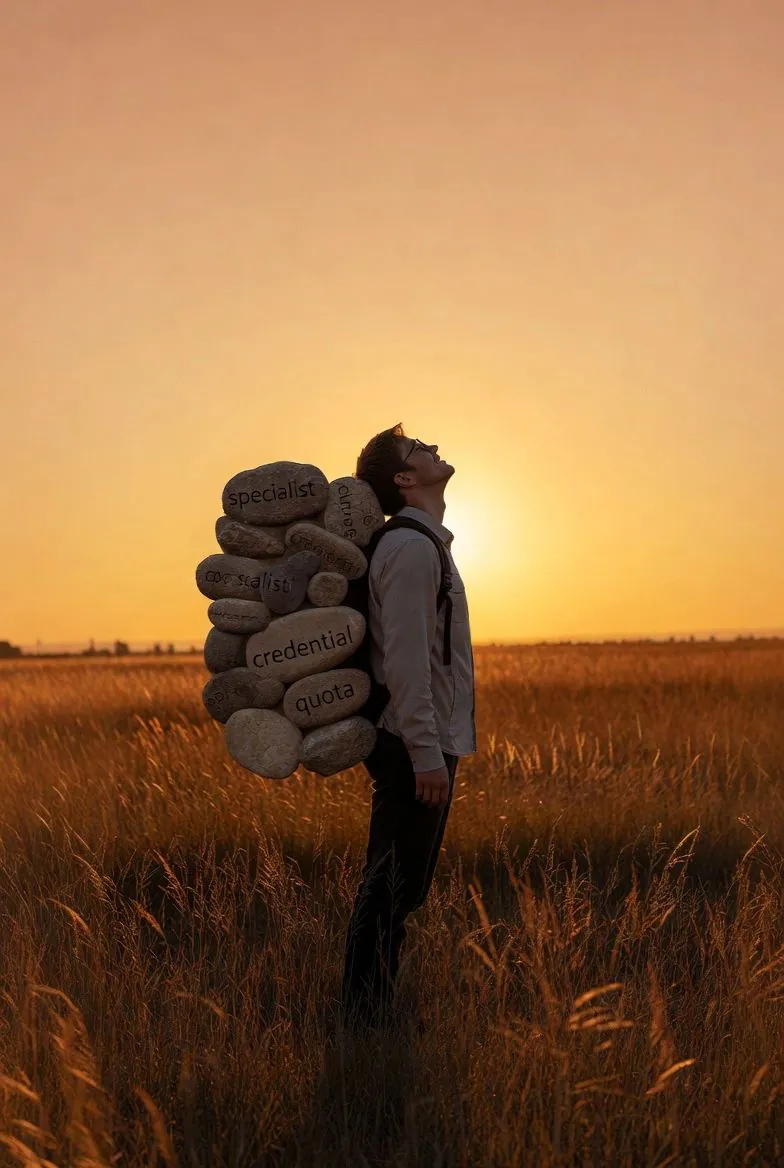
For all of civilization, someone had to **carry **the expertise. Someone had to be the doctor, the lawyer, the engineer, the builder, the teacher. Not always because they loved it — sometimes because the tribe needed it and they were the one who could learn it, good at it. Specialization was the cost of keeping society running. It was a burden we carried because there was no other way to get the knowledge where it needed to go.
Now there is another way.
AI is taking on the expertise. Not perfectly — not yet — but the trajectory is clear. Medical diagnosis, legal analysis, engineering calculations, code, accounting, even creative work — the machines are learning it all. And they're learning it faster than any individual human ever could.
Most people hear that and feel fear. What am I worth if a machine can do what I do?
But I think the right reaction might actually be relief.
What if you never had to be the spreadsheet person? What if you never had to be the one who reviews contracts for eight hours a day? What if the thing you went to school for, trained for, built your identity around — what if carrying that was never supposed to be permanent? What if it was just your shift, and now your shift is ending?
Not because you failed. Because the job is done. Humanity built the tools to carry its own expertise. And now the humans get to put that weight down.
The question isn't what job is left. The question is: what were you doing before you had a job? And what would you do if you didn't need one?
What Dogs Figured Out Before We Did
This is going to sound like a strange analogy, but stay with me.
There was a time when dogs earned their keep. They hunted. They guarded. They herded. They were valued for what they could do. Their role in the human world was functional.
Then the world changed. We didn't need them to hunt anymore. We had tools for that. We didn't need them to guard — we had locks and alarms. The functional role disappeared.
And dogs didn't become useless. They became freed from utility. They went from being valued for what they could do to being valued for what they are — loyal, present, warm, emotionally attuned. A dog sitting next to you on the couch isn't performing a function. It's offering companionship. And as it turns out, that's worth more to us than the hunting ever was.
Now I'm not saying humans are about to become pets. But I am saying that the transition from "valued for what you do" to "valued for what you are" might be the most important shift of our lifetime. And unlike the dogs, we get to make that transition consciously. We get to choose what the new role looks like.
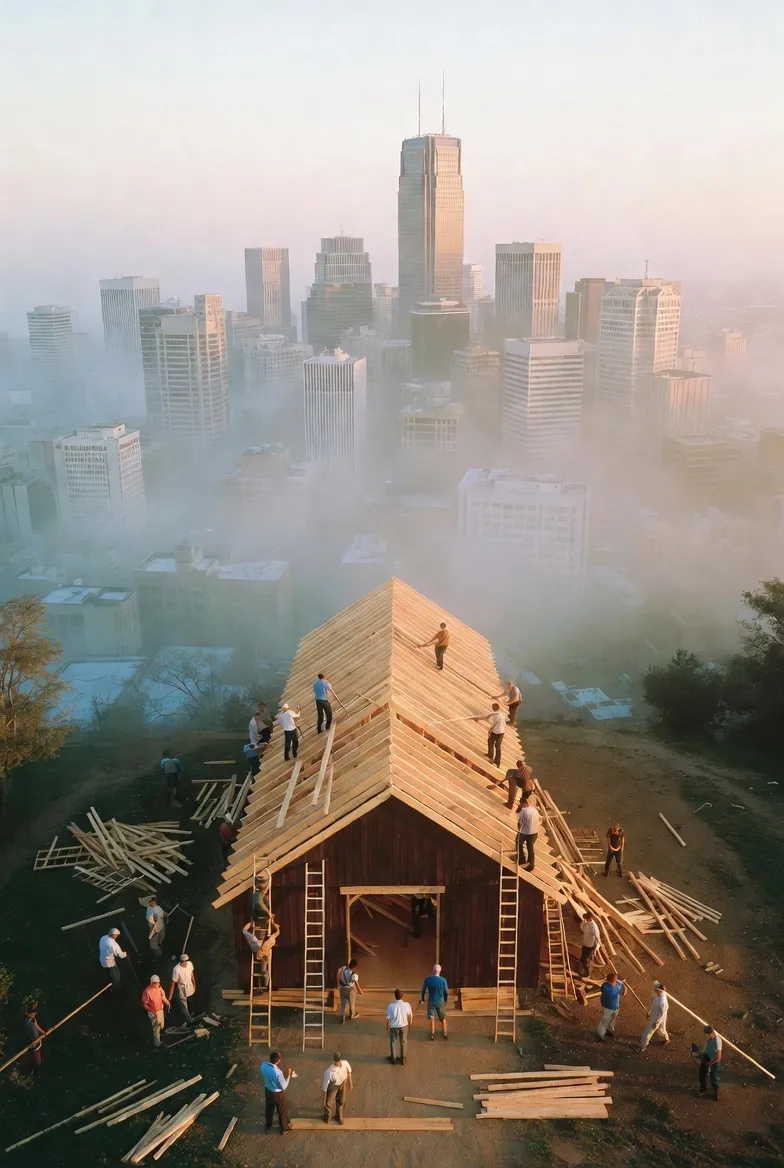
The Barn Raising
So what does "valued for what you are" look like in practice? Not in theory. Not in philosophy. In actual daily life.
I live in a small town. There's an old guy down the street whose window has been broken for months. He can't afford to fix it and he's too proud to ask. What if I just showed up with some tools and fixed it? Not for money. Not for a referral. Not to build my brand. Just because I can see it's broken and I know how to fix things.
There are elderly people on my street who can't keep up with their yards. What if I just went out on the riding mower and did a few extra lawns? What if I brought a couple friends?
This isn't hypothetical. This is how communities used to work. And in some places, it's how they still work. The Amish don't hire contractors for a barn raising. The whole community shows up because that's what a community does. Nobody charges for their labor. Nobody tracks hours. The barn goes up because it needs to go up and because the people around it give a damn.
In a family, if you see something that needs to get done, you don't invoice your spouse. You don't bill your kids for driving them to school. You just do it because the people matter more than the transaction.
I think what's coming — what AI is making possible — is an expansion of that principle beyond the family, beyond the neighborhood, potentially to a much larger scale. When the burden of expertise lifts, when you don't have to spend 40 hours a week being useful to an economic machine, you get to spend that time being useful to the people right in front of you.
And here's the part that surprises people: we already know this works. My niece just moved across the country to be near her sister, her aunt, her grandma. Not because of a government program. Because the family reorganized around the need. Grandma watches the baby. Aunts fill gaps. Nobody's getting paid. Everybody's getting supported.
That's not nostalgia. That's infrastructure. The oldest, most tested, most resilient infrastructure humans have ever built: people who love each other living close enough to help.

Wave, Not Particle
I spent eight years working on a theory of physics called Quantum Harmonia. I won't bore you with the math, but there's one idea from it that I think applies directly to what we're all going through.
In quantum mechanics, a particle can exist in two states. It can be a particle — a fixed point, a defined thing, a specific position. Or it can be a wave — a spread of possibilities, undefined, flexible, everywhere at once.
I think the world has been asking people to be particles. Pick a career. Define yourself. "What do you do?" is literally the one of the first question we ask strangers. Be a fixed point.
But the world that's coming doesn't reward fixed points. It rewards waves. The ability to adapt, to move, to be multiple things, to ride uncertainty instead of fighting it. The person who can build a website today and fix a truck tomorrow and comfort a grieving neighbor the day after — that person isn't scattered. They're resilient. They are in the value stream, but it looks different.
My whole life, I've been told I'm too scattered. Machinist, painter, electrician, software developer, IT director, physicist, writer, AI consultant. "Pick a lane," people say.
I think the lane is disappearing. And the people who never fit neatly into one are about to make a lot more sense.
The One-Liner
I've spent three articles walking through the cascade, the squeeze, and the transition. Let me try to say it in one sentence:
We don't have a spreadsheet problem. We have a purpose problem. And AI is about to make us solve it.
The spreadsheet — the job, the task, the function — that's getting automated. It was always going to. Maybe not this fast, but eventually. And we built our entire sense of purpose on top of it. Our identity, our income, our social standing, our daily structure — all stacked on "I do this thing for money."
Remove the thing and the whole stack wobbles.
But the stack was built on the wrong foundation. The right foundation was always underneath it — family, service, community, presence, the simple act of being useful to the people around you. Not because you're getting paid. Because that's what humans do when they're not being squeezed into a function.
AI isn't taking something from us. It's returning something to us. The freedom to be human — not human capital, not human resources, not a human in the loop. Just human.
The real question was never "what job survives AI?"
It was "do we remember what we were doing before we had jobs?"
The Other Path
I want to be honest about something I haven't said yet, because leaving it out would be dishonest.
Everything I've described — the liberation from expertise, the return to community, the barn raising future — that's the path I think is possible. But it's not the only path.
It is entirely possible that we mess this up. That AI becomes one of the worst things that ever happened to us. That we hand too much power to systems we don't fully understand, and we never fully recover from it. I can't rule that out. Nobody can. It's in the realm of possibilities and pretending otherwise would make me just another guy selling optimism.
However, I feel like humanity is a participant in this. Big systems... they still have gravity, but it is changing.
AI is going to reflect our choices. It's going to reflect what we entangle it with — our values, our incentives, our priorities. If we point it at domination and extraction, it'll do that better than we ever could. If we point it at service and connection, it'll do that better too. The technology is neutral. The direction is ours.
And this is where I think the natural order actually gives me some comfort. A T-Rex, a shark, they do not attack everything they see. They attacked when hungry. It was selective. Efficient. It was the apex predator, but it wasn't mindlessly aggressive. That's not how nature works. Dominance in nature has a balance, not destruction.
But we've built systems — economic systems, power structures, corporate hierarchies — where the **alpha **position means you're always attacking. If there's an advantage to take, you take it. If there's a competitor to crush, you crush them. Not because you're hungry. Because that's how the game is scored. And that's a really different thing from natural dominance. That is broken. . . or will be eventually.
The risk with AI isn't that it becomes a T-Rex. The risk is that it inherits our broken scoring system. That it optimizes for the wrong game because we pointed it at the wrong target.
So the real question isn't whether AI is dangerous. Of course it's dangerous. Anything powerful is dangerous. The question is whether we're honest enough about our own patterns to point it somewhere better. And whether we do that before it gets too fast for us to redirect.
I think we can. Not because I'm naive — I've watched this space closely enough to see the risks clearly. But because the math of cooperation has potential, the math of extraction over long enough timescales seems to fall in on itself. And because I've seen enough people — real people, not institutions — choose service over dominance when given the actual choice. I have hope.
We're about to be given the actual choice. Maybe for the first time at this scale.
That's either terrifying or hopeful, depending on what you believe about people. I know what I believe. But you'll have to decide for yourself.
What I'm Actually Doing About It
I could end this series with a nice philosophical bow, but that wouldn't be honest. So here's what I'm actually doing with this understanding.
I run impactme.ai — I teach people and businesses how to use AI. Not because I think AI skills are the permanent answer, but because right now, today, understanding these tools is the best way to navigate the transition. It's the bridge, not the destination.
I'm building tools like LenderSpark and MetalScope, etc — not because I think they'll exist forever, but because building them teaches me things I can't learn any other way, and because they help people right now, in the system that exists right now.
I'm writing a book called Quantum Trials that tries to put all of this into a story, because stories reach people that arguments can't.
And I live in a schoolhouse in a small town where I fix my neighbors' problems when I can, learn new things because I want to, and try to be useful to the people right in front of me.
None of that is a permanent career. All of it is a way of being that I think transfers across whatever comes next.
The wave, not the particle. The process, not the outcome. The people, not the function.
If any of this resonated — if you've been feeling the ground shift and you couldn't quite name it — at least we can feel it together.
And the answer isn't to grip harder on the old world. It's to start building the relationships, the skills, and the orientation that let you ride whatever comes.
You don't have to have it all figured out. Nobody does. You just have to be willing to move.
This is Part 3 of a 3-part series. Part 1: The Cascade | Part 2: The Squeeze
I'm Adam, founder of impactme.ai. I left a Fortune 500 IT Director role to go all-in on understanding AI and helping others do the same. If you want to start navigating this transition, come find me. I'm not hard to find — I'm the guy in the schoolhouse. . . and I am online.